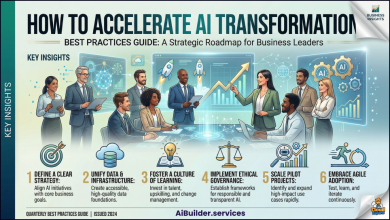
The Role of AI in Digital Transformation: Rewiring for Digital and AI
Digital transformation now requires organizations to fundamentally "rewire" themselves—restructuring operating models, capabilities, talent, culture, and leadership—to capture sustained value at scale.

 In this article Harvard explores The Role of Artificial Intelligence in Digital Transformation
Digital transformation means adopting digital technologies to fundamentally rethink and reshape business operations, models, and customer value delivery.
It tackles inefficiencies, boosts agility, enables data-driven decisions, and improves experiences.
They stress that in today’s fast-evolving landscape—with shifting industries and customer demands—AI is pivotal for making transformation practical and sustainable, allowing organizations to adopt changes gradually rather than through risky “big bang” overhauls (as Columbia Business School Professor Rita McGrath advises).
The article highlights four key AI levers that organizations must master to drive effective digital model transformation:
Strategy — AI enables dynamic, continuously evolving strategies through machine learning, predictive analytics, automation, and personalization.
Amazon uses AI for real-time inventory analysis, predicting shortages, rerouting deliveries, and speeding up shipping. Netflix leverages algorithms to analyze viewing patterns and deliver hyper-personalized recommendations, guiding content creation and investment decisions.
Governance — Robust data governance is essential to mitigate risks like security issues, ethical problems, inefficiencies, and algorithmic bias (e.g., biased hiring tools trained on prejudiced data). Solutions include diverse datasets, audited processes, inclusive teams, accountability mechanisms, and regular performance reviews.
Architecture — Scalable, interconnected infrastructure (especially cloud platforms) is the “plumbing” that allows AI to function effectively across systems. General Electric (GE) deployed cloud-based platforms to analyze real-time sensor data from machinery, predict failures, and optimize maintenance schedules.
Culture — Transformation fails without a supportive culture that breaks down silos, encourages data sharing, and fosters collaboration. AI helps by enabling faster insights and workflows. Microsoft under Satya Nadella embraced a “growth mindset,” cross-functional teams, and AI-driven decision-making to become a leader in cloud and AI innovation.
Benefits include greater strategic flexibility, cost reductions via automation, enhanced customer satisfaction through personalization, improved efficiency, and sustained innovation. Challenges encompass ethical risks (bias, misuse), security vulnerabilities, cultural resistance, and the need for strong leadership and infrastructure.
Rewiring for Digital and AI
The McKinsey article “Digital transformation: Rewiring for digital and AI“ describes the new corporate strategy for an era accelerated by generative AI, agentic AI, and advanced technologies.
Digital transformation now requires organizations to fundamentally “rewire” themselves—restructuring operating models, capabilities, talent, culture, and leadership—to capture sustained value at scale.
Leadership (especially from CEOs and C-suite executives) is the decisive factor in moving beyond pilots and incremental changes to enterprise-wide, high-impact outcomes. The collection draws analogies (e.g., how elite athletes train for peak performance under pressure) to illustrate how companies can build resilience, agility, and competitive advantage amid rapid tech evolution.
Key themes and highlighted insights from featured pieces in the collection include:
Leadership’s central role in raising the stakes with AI – AI, gen AI, and agentic AI have dramatically increased the urgency and potential of digital transformation. Companies must address challenges like scaling beyond experiments, bridging business problems with tech possibilities, and fostering adoption. Insights from athletic training metaphors emphasize disciplined preparation, continuous improvement, and adaptive mindsets for leaders navigating uncertainty.
CEO and executive imperatives – Successful CEOs act as “digital-value guardians,” reimagining the business boldly in a digital age, setting visionary yet pragmatic agendas, and ensuring transformations generate transformative value. Top leaders must prioritize value creation over tech for tech’s sake, promote enterprise-wide adoption, and align investments with measurable outcomes (e.g., one piece notes tech leaders following six imperatives can achieve 3x EBITDA impact through value-focused spending).
Rewiring the enterprise for outcompetition – Drawing from examples of companies that have successfully “rewired,” the collection stresses building integrated capabilities across technology, data, processes, and people. This includes scaling AI in functions like manufacturing (e.g., COOs moving from pilots to performance), enhancing B2B sales with tech innovations, and creating adaptive operating models that balance performance and resilience.
Talent, adoption, and sustaining change – Common pitfalls include failing to sustain improvements, underinvesting in talent, or lacking cross-functional alignment. Success factors involve the five key talent elements (e.g., right skills, mindsets, and structures), fostering adoption, and ensuring transformations deliver ongoing value rather than one-off gains.
This positions leadership not as a supporting function but as the primary driver—CEOs and boards must actively champion rewiring efforts to outcompete in a tech-driven landscape.