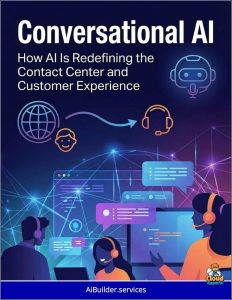
Conversational AI – How AI Is Redefining the Contact Center and Customer Experience
What began as simple chatbots and IVR menu optimizers has evolved—rapidly—into agentic AI, real-time generative coaching, hyper-personalized omnichannel journeys.
The contact center is no longer defined by rows of headsets, endless hold music, and agents racing against average handle time.
It has become the proving ground for one of the most profound business transformations of our generation: the fusion of artificial intelligence with human empathy at massive scale.
What began as simple chatbots and IVR menu optimizers has evolved—rapidly—into agentic AI, real-time generative coaching, hyper-personalized omnichannel journeys, and predictive resolution engines that often solve issues before the customer even realizes they have one.
Industry surveys now show over 80% of contact center leaders viewing AI as essential to delivering 24/7, always-on support, while forward-thinking organizations report 30–50% gains in efficiency, dramatic improvements in first-contact resolution, and—perhaps most surprisingly—higher agent satisfaction as repetitive work disappears and meaningful customer conversations take center stage.
Yet for every success story there are cautionary tales: rushed deployments that frustrate customers, data strategies that create more silos than insights, and implementations that treat generative AI as a fancy auto-complete tool rather than a strategic coworker. The gap between AI hype and sustainable value has never been wider.
This book is written for the executives, directors, and practitioners who refuse to treat AI as a one-off project or a cost-cutting shortcut. Instead, we explore what it truly means to build an AI-first contact center—one where technology amplifies human capability, data becomes a competitive moat, and every interaction (voice, digital, messaging, social, proactive outreach) contributes to deeper customer loyalty and measurable business outcomes.
Through frameworks, real-world architectures, implementation roadmaps, and lessons from early adopters navigating the realities of 2025–2026 deployments, we will answer the questions that matter most right now:
- Where should you start (and where should you absolutely not)?
- How do you move from pilot to production without breaking trust or compliance?
- What new roles, skills, and cultural shifts are required when AI becomes a daily coworker?
- How do you measure success when traditional metrics (AHT, CSAT) tell only part of the story?
- And crucially—how do you keep the human connection alive as intelligence scales?
The contact center is no longer just a service function. In the AI era, it is becoming the nerve center of the entire customer relationship. Those who master this transition will not merely survive—they will redefine what great customer experience looks like.
Welcome to the intelligent contact center. The future is already answering the call.
xx
The contact center is undergoing its most significant transformation since the shift to omnichannel support, driven by the rapid maturation and enterprise-scale deployment of artificial intelligence. As of early 2026, AI is no longer a peripheral enhancement but the central force redefining customer experience (CX), operational efficiency, workforce dynamics, and competitive differentiation. Organizations that strategically integrate AI are shifting contact centers from traditional cost centers to proactive value drivers—delivering faster resolutions, deeper personalization, and measurable revenue impact while elevating agent satisfaction by eliminating repetitive tasks.
Market momentum underscores this shift. The global call center AI market, valued at approximately $4 billion in 2025, is projected to grow at a compound annual rate of 21–24% through the early 2030s, reaching $11–30 billion by 2030–2035 depending on segment focus (voice AI, agentic systems, analytics). Conversational AI and agentic deployments are accelerating fastest, with forecasts indicating AI could autonomously handle up to 80% of common customer service issues and reduce labor costs by tens of billions annually. Adoption is near-universal: over 98% of contact centers now use AI in some capacity, with 99% of organizations maintaining or increasing investment. Cloud-based solutions dominate (often >75% share), enabling scalable generative AI, real-time coaching, predictive routing, and seamless omnichannel orchestration.
Key benefits driving this surge include:
- Efficiency gains of 30–50% in handle time and first-contact resolution through generative copilots, automated deflection, and intelligent self-service.
- Customer outcomes — higher satisfaction and loyalty, with many consumers favoring human-like AI when it delivers fast, accurate help.
- Agent empowerment — 70–80% of agents report improved productivity, more enjoyable work, and better collaboration when augmented by AI tools.
- Proactive CX — predictive analytics and sentiment detection enable issue anticipation, reducing inbound volume and friction.
Yet the path is not without challenges. Early 2026 reveals a reality check: rushed implementations can erode trust, service quality may temporarily dip amid complex deployments, and overreliance on AI risks atrophying human skills or frustrating customers expecting empathy. Agent headcount reductions (via attrition or optimization) are widespread, with over 80% of organizations anticipating workforce adjustments. Success demands more than technology—it requires redesigned processes, robust governance, ethical AI practices, continuous agent upskilling, and hybrid human-AI models that preserve the human connection.
This book, AI-First Contact Centers: Transforming Customer Experience in the Age of Intelligent Automation, provides leaders with practical frameworks to navigate this transition. It covers prioritized starting points (e.g., agent augmentation over full automation), production-scale roadmaps, new performance metrics beyond AHT and CSAT, emerging roles like AI orchestrators, and strategies to build trust while scaling intelligence. In 2026 and beyond, the contact center is evolving into the enterprise’s intelligent nerve center. Organizations that master AI-human collaboration will not only lower costs and resolve issues faster—they will forge unbreakable customer loyalty and position themselves as CX leaders in an increasingly digital-first world. The call is coming in; the intelligent response is already here.