How Uber Scaled AI to 60,000 Tasks Per Week: The Power of the Model Context Protocol (MCP)
Uber scaled AI to 60,000 weekly tasks via MCP ("USB-C for AI"), standardizing connections across 10,000+ services for 5,000+ engineers and 1,500 agents.

 Uber has rapidly moved from AI pilots to enterprise-scale operations.
More than 5,000 engineers—95% of its engineering workforce—now use AI monthly for agentic workflows. The company runs 1,500 monthly active agents that execute over 60,000 tasks weekly.
This achievement rests on the Model Context Protocol (MCP), an open-source standard often called the “USB-C for AI.”
The Scale Challenge
Uber operates more than 10,000 services, creating massive fragmentation. Without standardization, every AI agent had to rediscover how to interact with each service, resulting in duplicated effort, isolated silos, and a “Wild West” of custom integrations. MCP solves this by providing a universal interface between AI models and the company’s sprawling infrastructure, turning potential chaos into a governed, scalable system.
|
 Download the full
 What is MCP?
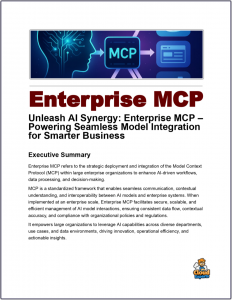
MCP standardizes how AI applications (such as Claude, ChatGPT, Cursor, or VS Code) connect to data sources, tools, and workflows. It enables “build once, integrate everywhere” development. For developers, it reduces integration complexity; for AI apps, it expands tool ecosystems; for end users, it creates more capable agents that can act autonomously, such as managing calendars or building applications from designs.
At Uber, MCP shifted the organization from bespoke, non-reusable integrations to a standardized connection model. As one leader noted during rollout: “Without standardization this starts becoming chaotic very quickly… MCPs are not just important; they really are what make AI usable at Uber.”
The MCP Gateway and Registry: Automation at Scale
To handle 10,000+ services efficiently, Uber built a centralized MCP Gateway and Registry as the control plane. A config-driven pipeline automatically converts service definitions into AI-ready tools.
The IDL-to-Tool Pipeline works as follows:
- Orchestrator: Crawls Interface Definition Language (IDL) files (Proto and Thrift) across services. LLMs generate MCP tool descriptions from message names and existing comments.
- SME Loop: Service owners (Subject Matter Experts) review and refine the LLM-generated descriptions for accuracy and proper invocation guidance.
- Automated PR Workflow: Updates trigger Pull Requests. Unified Scanning APIs automatically check for risky patterns or unintended endpoint exposures.
- Gateway Service: Validated definitions are stored in object storage and served as the single source of truth to all AI consumers.
This automation dramatically reduces manual work while maintaining quality and control.
Security and Governance: Managing the Blast Radius
AI agents act at superhuman speed, amplifying the potential impact of errors or unauthorized access. Uber embeds security into every layer of the MCP platform:
- Centralized Authorization: Agents receive only explicitly granted permissions via Uber’s central auth systems.
- PII Redactor: A dedicated service automatically scrubs Personally Identifiable Information from all data streams.
- Unified Scanning: Ongoing code and metadata scans detect vulnerabilities or bad patterns.
- Mutable Endpoint Guardrails: Blockers prevent agents from calling endpoints that could disrupt production services.
The system also distinguishes internal versus third-party MCP servers, applying stricter controls where needed. One-off playground environments were replaced with version-controlled, centrally managed code for better observability and traceability.
Three Ways to Consume MCP
Uber offers three tailored surfaces for different needs:
- Uber Agent Builder (No-Code): Enables non-engineers to build productivity agents. Users @mention MCP servers in instructions. To reduce hallucinations, builders can select specific tools and apply Parameter Overrides (locking values statically).
- Uber Agent SDK (Code-First): For high-impact applications like Grocery Assistant, Auto Care coordination, and Customer Support. YAML configs load tools and handle complex orchestration, including memory and chat history management.
- Coding Agents: Integrated with IDEs (Cursor, Cloud Code) via the afx CLI. Background “Minion” agents running on cloud infrastructure generate approximately 1,800 code changes per week, delivering major productivity gains.
The Road Ahead: From Tools to Skills
Uber is evolving beyond single-endpoint “tools” to sharable “Skills”—reusable recipes or conventions for complex, multi-step processes that teams can adopt organization-wide.
Key roadmap items for the MCP Registry include:
- Evaluation Metrics: Surface SLAs, reliability scores, availability, and performance data so users and agents can select high-quality tools.
- Tool Search Tool: Agents will discover and load tools on demand to combat context bloat and keep prompts efficient.
- A/B Testing for Skills: Test different versions to measure output quality and correctness.
- Skill Sharing: Standardized, versioned complex workflows that promote reuse across teams.
Why This Matters
Uber’s implementation demonstrates that scaling AI depends less on raw model power and more on robust infrastructure. By treating MCP as a foundational standard rather than an experiment, Uber created a secure, discoverable, and efficient environment where thousands of agents can operate reliably.
The results speak for themselves: near-universal engineer adoption, massive task volume, and accelerated development velocity. Other large organizations face the same questions. As agents gain deeper access to core systems, standardization becomes essential.
Without a protocol like MCP, companies risk infrastructure chaos and uncontrolled blast radius. With it, they unlock governed, high-velocity AI that can transform operations at scale.