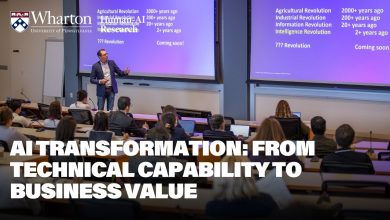
How to Accelerate AI Transformation – Tackling the Last Mile Problem
Many organizations fail to realize AI value by treating it as a mere toolkit. Success requires redesigning workflows, rethinking tasks and metrics, user collaboration, and closing the "last mile" gap for real-world impact.

 In this MIT Sloan article visiting senior lecturer Paul McDonagh-Smith addresses why many organizations struggle to achieve measurable business value from AI despite widespread adoption.
The core issue is not technology adoption itself, but failing to fundamentally adapt work, workforce, and workplace systems around AI.
- Many companies treat AI narrowly as a toolkit plugged into existing workflows for efficiency gains, rather than as a new operating system that requires redesigning how work gets done.
- Traditional job roles and performance metrics no longer fit; returns remain elusive because organizations don’t close the “last mile” gap between AI’s technical potential and real-world impact.
Main Recommendations for Acceleration
- View AI as an Operating System: Shift from layering AI onto old processes to redesigning entire workflows and measuring impact with new metrics. This enables coherent, systemic value creation instead of fragmented use.
- Adopt a Mindset of Exploration and Evolution: Move beyond understanding models (rules-based → machine learning → generative AI) to practical experimentation—testing AI on real problems to discover what works and anticipate future limitations (e.g., data and compute demands).
- Rethink Work at the Task Level: Break jobs into 15–20 core activities/tasks rather than treating entire roles as the unit of analysis. AI automates some tasks and augments others; organizations must explicitly redesign workflows to divide labor between humans and AI systems.
- Develop New Performance Metrics: Replace outdated measures with AI-appropriate ones focused on decision speed, human-AI collaboration quality, insight feedback loops, decision accuracy, system autonomy, and organizational “understanding” by AI.
Closing the “Last Mile” Gap in AI Transformation
The “last mile” represents the critical and often most challenging phase of AI adoption: bridging the gap between a technically successful AI model or prototype and its actual delivery of measurable business value in real-world operations. As Paul McDonagh-Smith explains, “AI last-mile engineering is fundamentally about reducing the space between AI’s potentiality and its real-world impact.”
Many organizations excel at building or fine-tuning powerful models, yet these systems frequently fail to integrate into everyday decision-making, workflows, and culture—resulting in stalled initiatives, low adoption rates, and disappointing ROI.
AI initiatives often stall not because the technology doesn’t work in a lab or controlled test, but because they are not embedded into the messy realities of how people actually work. Key barriers include:
- Lack of clear problem definition — teams deploy AI for its own sake rather than targeting specific, high-impact business challenges.
- Top-down imposition — solutions designed in isolation by technical teams or executives without input from frontline users.
- Overemphasis on raw capability (e.g., model accuracy or compute power) at the expense of contextual fit and usability.
- Insufficient trust, transparency, and governance, leading to resistance or underutilization.
- Inadequate measurement systems that fail to track true value creation.
Practical Strategies to Close the Gap
To successfully cross the last mile, organizations should adopt a disciplined, user-centric, and iterative approach:
- Clearly Define the Business Problem First: Start every AI project by articulating a precise, outcome-oriented problem that AI is intended to solve. Avoid vague goals like “implement generative AI.” Instead, focus on questions such as: “How can we reduce customer query resolution time by 40% while maintaining quality?” or “How can we improve forecast accuracy in supply chain planning?” This ensures alignment between technical efforts and business priorities.
- Involve End-Users from the Very Beginning: Co-create solutions with the people who will ultimately use them. Frontline employees and domain experts bring invaluable insights into workflow nuances, pain points, and practical constraints that technologists might miss. User involvement increases ownership, reduces resistance, and leads to more intuitive, adoptable systems. Treat AI design as a collaborative process rather than a technology push.
- Prioritize Real-World Context Over Pure Technical Power: Success depends less on cutting-edge models and more on how well the system fits into the organization’s specific processes, data environment, culture, and decision rhythms. Map existing workflows in detail, identify where AI can augment or automate tasks, and design human-AI collaboration patterns that feel natural and valuable to users.
- Adopt a “Ship Small, Learn Fast” Mindset:
Move away from big-bang deployments toward rapid experimentation. Develop small, focused applications or pilots, deploy them quickly in controlled settings, rigorously measure outcomes, gather feedback, and iterate. Scale only what demonstrably works. This agile approach minimizes risk, accelerates learning, and builds momentum through visible early wins. - Build Trust Through Strong Governance, Transparency, and Continuous Oversight: Trust is foundational for sustained adoption. Implement clear governance frameworks that address ethics, bias, accountability, and data privacy. Make AI decision processes explainable where possible. Provide ongoing training, feedback mechanisms, and human oversight (especially in high-stakes areas). Monitor systems continuously rather than treating deployment as a one-time event.
Supporting Elements for Last-Mile Success
Closing the last mile works best when combined with the broader shifts outlined in the article: treating AI as an operating system (not just a toolkit), breaking jobs into 15–20 core tasks for redesign, and introducing new performance metrics focused on decision speed, collaboration quality, insight loops, accuracy, autonomy, and organizational understanding by AI systems.
Overall Takeaway: The last mile is where AI transformation moves from potential to performance. Organizations that approach it with clear problem focus, deep user collaboration, contextual awareness, rapid iteration, and trust-building practices are far more likely to realize substantial, sustainable value from their AI investments. McDonagh-Smith’s guidance underscores that this phase requires as much (or more) attention to organizational and human factors as to the technology itself.