AI – The Executive Imperative
Why every C-suite leader must treat artificial intelligence as a board-level, enterprise-wide priority in 2025 and beyond.

 The message is no longer ambiguous: artificial intelligence has moved from experimental sandbox to the single most powerful lever for competitive advantage, value creation, and in some cases corporate survival.
McKinsey’s latest estimates put the annual economic value of generative and other advanced AI at $4.4 trillion globally — roughly the GDP of Germany.
Goldman Sachs projects that generative AI alone could raise global GDP by 7 % over the next decade. Meanwhile, companies that fail to integrate AI at scale risk falling irreversibly behind: Stanford’s 2025 AI Index shows that firms in the top quartile of AI adoption are already pulling away from the bottom quartile by 3–5× in revenue growth and 2–3× in profitability.
For executives, the implication is stark. AI is not an IT project. It is not a “digital transformation” sub-workstream. It is the defining executive imperative of this decade.
1. The New Competitive Moat Is Algorithmic
Traditional sources of competitive advantage — brand, scale, network effects, intellectual property — remain important, but they are increasingly insufficient without an algorithmic moat.
- JPMorgan Chase now processes 100 % of its equity trades and nearly all corporate loan applications with AI-driven systems, reducing risk-weighted assets and cutting processing time from weeks to minutes.
- Ocado, the British online grocer, runs its warehouses with an AI system that has achieved 99.7 % picking accuracy and 4× the productivity of human-only facilities.
- Moderna designed its COVID vaccine in two days using AI-augmented mRNA design — a capability it is now productising as an AI-powered drug development platform.
In each case, the advantage is compounding: the more data the system processes, the better it gets, creating a flywheel that late entrants cannot easily replicate.
2. The Half-Life of Non-AI Advantage Is Collapsing
Harvard Business Review analysis of S&P 500 composition shows that the median tenure of a company on the list has fallen from 32 years in 1965 to roughly 16 years today. AI will accelerate this churn.
Goldman Sachs predicts that 300 million full-time jobs (roughly 18 % of global work) are exposed to automation by generative AI. While new roles will be created, the transition will be brutal for incumbents that move slowly. Blockbuster, Kodak, and Nokia are historical cautionary tales; tomorrow’s equivalents will be firms that treated AI as a 2028–2030 priority rather than a 2025 one.
3. The Boardroom Mandate – What “AI-First” Actually Means
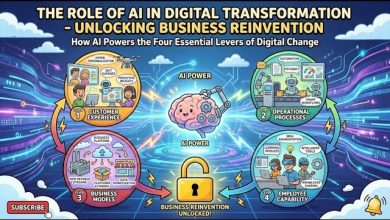
Treating AI as an executive imperative requires five non-negotiable shifts:
A. CEO-Level Ownership and Narrative
The most successful AI transformations (Microsoft under Satya Nadella, DBS Bank under Piyush Gupta, DBS named “World’s Best Digital Bank” multiple years running) share one trait: the CEO personally owns the AI narrative internally and externally. The CEO must be able to explain — in plain language — how AI changes the company’s value proposition, cost structure, and risk profile.
B. A Unified AI Operating Model
Most companies still treat AI as hundreds of disconnected pilots. The leaders (typically 18–24 months ahead) have created a single AI platform layer — shared infrastructure, governance, data, talent, and funding — that sits above lines of business. Think of it as the “AI nervous system” of the enterprise.
C. Talent as the Scarce Resource
The global supply of experienced AI engineers, data scientists, and translation-layer leaders (those who can connect AI capability to business P&L) remains severely constrained. Top performers command 40–100 % premiums and unprecedented autonomy. Companies that win the war for talent do three things differently:
- Pay at the 90th percentile or above
- Offer meaningful equity upside tied to AI outcomes
- Create internal AI academies that upskill thousands of existing employees (Salesforce’s Trailhead model applied to AI)
D. Data as the New Oil — But Only If Refined
90 % of AI project failures still trace back to poor data quality, accessibility, or governance. The executive imperative is to treat data as a balance-sheet asset: measure it, audit it, and fund its remediation with the same rigor as capital expenditure.
E. Responsible AI as Table Stakes, Not Nice-to-Have
Regulators are moving faster than most executives realise. The EU AI Act is already in force (2024–2026 phased implementation), China has comprehensive AI regulations, and the U.S. is advancing sector-specific rules (healthcare, finance, hiring). Boards that ignore liability, bias, and explainability risk multi-billion-dollar fines and catastrophic reputational damage.
4. The Financial Imperative – Show Me the ROI
CFOs increasingly demand line-of-sight to returns. The highest-ROI use cases in 2025 cluster in four areas:
| Domain | Typical ROI Range | Time to Value | Example Leaders |
|---|---|---|---|
| Customer Experience | 15–40 % revenue uplift | 6–12 months | Airbnb, Stitch Fix, Lemonade |
| Supply Chain & Operations | 10–30 % cost reduction | 9–18 months | Maersk, Flex, Walmart |
| Software Engineering | 30–50 % productivity gain | 3–9 months | GitHub (Copilot), JPMorgan, Meta |
| Risk & Compliance | 20–60 % reduction in loss | 12–24 months | HSBC, American Express, Ping An |
Notable: companies that combine two or more domains (e.g., AI-driven dynamic pricing + predictive maintenance) routinely see compounded returns north of 100 % within 24 months.
5. The Execution Playbook – First 100 Days
For executives ready to move:
- Appoint a Chief AI Officer reporting directly to the CEO (not the CIO).
- Conduct a 6-week AI Opportunity Scan across the entire value chain with external help if needed.
- Secure a dedicated AI transformation budget (1–3 % of revenue is the new benchmark for leaders).
- Launch 3–5 lighthouse projects with clear 12-month P&L impact and enterprise-wide visibility.
- Establish an AI Ethics & Risk Committee at board level.
Conclusion
History belongs to the bold, but in the age of AI it belongs to the prepared. The companies that will dominate the next decade are not those with the biggest R&D budgets or the most charismatic founders. They are the ones whose executive teams internalise — today — that artificial intelligence is no longer a technology trend. It is the organising principle of competitive strategy itself.
The question is no longer whether your company will be disrupted by AI.
The question is whether you will be the disruptor or the disrupted.
Act accordingly.