The AI First Boardroom – Building AI into the DNA of an Organization
The New Competitive Imperative: Why AI is a C-Suite Transformation, Not an IT Project

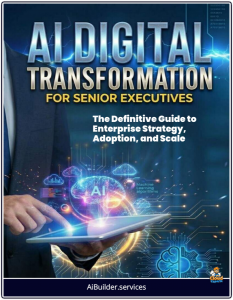 The adoption of enterprise AI represents a fundamental competitive inflection point, on par with the arrival of the internet or cloud computing.
While 92% of companies plan to increase their AI investments, a staggering 95% of generative AI (GenAI) pilots fail to reach production. This disconnect reveals a critical, and often fatal, misunderstanding of what AI implementation truly requires.
The central thesis of this guide is: Enterprise AI is not a technology project; it is a C-suite-led transformation of the business.
A Board Level Imperative
Recent analysis of AI adoption successes and failures provides a clear verdict. The common “instinct is to delegate implementation to the IT or digital department, but over and over again, this turns out to be a recipe for failure”.
The reason for this high failure rate is that “getting real value out of AI requires transformation, not just new technology. It’s a question of successful change management and mobilization, which is why C-suite leadership is essential”. The challenge is “not a technology challenge. It is a business challenge that calls upon leaders to… rewire their companies for change”.
Enterprise AI is distinct from the ad-hoc, consumer-grade tools that have entered the popular lexicon. Unlike simple voice assistants, enterprise-grade AI initiatives must meet far higher standards for security, compliance, data privacy, and deep system integration. This requires complex, cross-functional collaboration between executive leadership, IT, data science, legal, and line-of-business teams, all working to translate AI capabilities into tangible business value.
Organizations that fail to grasp this populate the “AI Graveyard”. The 95% pilot failure rate is not due to weak models, but to organizational gaps. Projects collapse in production due to a “Trust Breakdown” (e.g., hallucinations), “Integration Fragility” with legacy systems, runaway “Cost Overruns,” “Governance Gaps” discovered too late, and a fundamental “Value Gap” where a impressive demo fails to deliver a measurable business outcome.
This moment is a new inflection point in strategy design, comparable to the creation of core strategic frameworks in the 1970s and ’80s. For leaders, the risk is “not thinking too big, but rather too small.” AI today is analogous to the internet 40 years ago; companies that “advance boldly today” will define their markets, while those that hesitate will “become uncompetitive tomorrow”.
This C-suite mandate is not merely an offensive strategy to create value; it is a critical defensive imperative. Recent studies show that while official, top-down AI adoption in many companies is “stalled,” frontline employees are not waiting. Over 54% of employees, particularly GenZ and Millennials, report they will use “unauthorized” AI tools if not provided with official ones. This “shadow AI” ecosystem operates completely outside of corporate governance, security protocols, and compliance oversight.
Therefore, the failure of executive leadership to sanction, fund, and lead a formal AI strategy does not mean AI is not in the organization. It means AI is present in an uncontrolled, ungoverned, and high-risk manner. A formal, C-suite-led strategy is the only way to mitigate this shadow risk and channel the organization’s clear demand for AI into a productive, secure, and competitive advantage.
From Adopter to AI-First Enterprise
This guide has charted the complete journey of enterprise AI adoption. It begins with the C-suite’s acceptance that this is a fundamental business transformation, not an IT project. It requires a new organizational framework for governance, risk, compliance, and—most importantly—people. This strategy is executed through a secure technical blueprint and scaled via an industrialized MLOps engine that turns isolated pilots into enterprise-wide factories.
The journey does not end with successful adoption. The final stage of maturity is the evolution into an “AI-First” or “Agentic” organization. This is a company that has moved beyond “scattered initiatives” and “strategic programs” to a state where autonomous, governed AI agents are embedded in core processes. These agents, which can “plan, act, remember, and learn,” will “completely change how companies are run and how they generate value”.
The path from an ad-hoc AI adopter to a mature, AI-first enterprise is long and complex. But it is not, at its heart, a technology race. It is a race to achieve the organizational, cultural, and strategic rewiring necessary to wield this technology effectively. The organizations that complete this transformation first will not just lead their industries; they will define the next era of competition.