How Toyota Built an AI Platform that Revolutionizes the Dealer Experience
Toyota transformed dealer operations using Amazon Bedrock and Claude to create an intelligent assistant that answers complex vehicle questions in seconds, serving 2,300+ dealerships with instant, accurate vehicle expertise.

 At AWS re:Invent Toyota Connected North America and Toyota Enterprise AI delivered a compelling presentation titled “How Toyota Built an AI Platform that Revolutionizes the Dealer Experience”.
Presented by Stephen Ellis from Toyota North America, Stephen Short from Toyota Connected North America, and Bryan Landes from AWS, the session highlighted Toyota’s journey in leveraging generative AI to transform dealership operations.
The core innovation is an intelligent assistant that provides instant, accurate answers to complex vehicle-related questions, empowering over 2,300 dealerships across North America.
This platform addresses longstanding inefficiencies in the automotive sales process, where dealers often struggle to match the depth of knowledge that tech-savvy customers bring from online research.
By integrating AWS technologies like Amazon Bedrock and Anthropic’s Claude model, Toyota has created a scalable system that handles more than 7,000 monthly interactions, covering multiple models and years from 2023 to 2026. This case study explores the background, challenges, solution, implementation, results, and key lessons from the project.
Background
Toyota has long been at the forefront of automotive innovation, but the rise of digital-savvy consumers has reshaped the dealer experience. Customers now arrive at dealerships armed with information from sources like YouTube, forums, and online reviews, expecting salespeople to provide precise, real-time details on vehicle specifications, pricing, trims, and accessories.
Historically, Toyota’s data was siloed across manufacturing, sales, and marketing teams, leading to outdated or inaccessible information. This gap not only frustrated dealers but also risked compliance issues, such as missing legal disclaimers or inconsistent brand messaging.
Toyota’s partnership with AWS dates back to 2018, supporting over 47 generative AI use cases across the organization. The dealer AI platform emerged from this collaboration, building on Toyota’s broader AI strategy to enhance mobility, safety, and customer engagement. Toyota Connected North America, a subsidiary focused on connected vehicle technologies, led the development, aiming to democratize AI access for non-technical users like dealership staff.
Problem Statement
The primary challenge was the inefficiency in dealer-customer interactions. Salespeople often resorted to generic responses like “Let me check on that” when faced with detailed queries, eroding customer trust and prolonging sales cycles. Key issues included:
- Data Accessibility and Staleness: Rigid ETL (Extract, Transform, Load) pipelines couldn’t keep pace with frequent updates, such as new model year releases or accessory changes.
- Compliance and Accuracy Risks: Responses needed to include mandatory disclaimers, adhere to brand voice, and avoid hallucinations or inaccuracies from AI models.
- Scalability for Diverse Queries: Dealers required support for natural language questions across a vast array of vehicles, without manual research that could take hours.
- Siloed Information: Integration across Toyota’s ecosystems was fragmented, leading to manual data handling and potential errors.
These problems were exacerbated by the need to serve thousands of dealerships, where quick, reliable information directly impacts sales conversions and customer satisfaction.
Solution Overview
Toyota’s solution is an AI-powered intelligent assistant that uses Retrieval-Augmented Generation (RAG) in its initial version (V1) and evolves into an agentic platform in V2.
The assistant allows dealers to query vehicle details in natural language, receiving citation-backed responses with images, disclaimers, and accurate data. It draws from official Toyota sources, ensuring reliability and compliance.
- V1: RAG-Based Assistant: Focused on semantic search and generation, this version processes queries through an intent router, retrieves relevant data via embeddings, and generates responses with Bedrock.
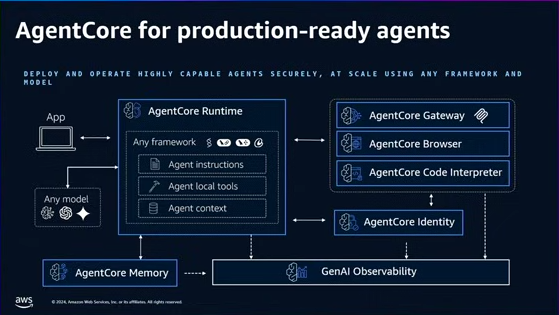
- V2: Agentic Platform: Shifts to a multi-agent system using Amazon Bedrock Agent Core, enabling actions like real-time inventory checks and eliminating ETL dependencies for fresher data.
The platform is deployed across dealerships and integrated into Toyota’s digital tools, making AI accessible without requiring technical expertise.
Implementation
The project was implemented in phases, starting with V1 prototypes and iterating based on feedback.
- Architecture Details:
- Frontend and Routing: Uses AWS Route 53 and Lambda@Edge for authentication, with an intent router to detect vehicle context and prevent prompt injections via an in-house tool called Prompt Guard. Conversation history is stored in DynamoDB.
- Backend: Hosted on Amazon EKS, with Amazon Bedrock for inference and OpenSearch Serverless as a vector database. SageMaker handles embeddings.
- Data Pipeline (V1): Orchestrated by AWS Step Functions and Glue, it chunks and summarizes JSON data from Toyota APIs, evaluates quality with LLM consensus, and ingests into OpenSearch.
- V2 Enhancements: Introduces an orchestrator and agent registry for routing. Agents (e.g., Product Expert and Product Support) connect directly to data via Model Context Protocol (MCP) servers. Agent Core provides runtime isolation, identity management, memory for caching, and observability with OpenTelemetry to Datadog.
- Technologies and Tools:
- Core AWS services: Bedrock (with Anthropic models), SageMaker, EKS, OpenSearch, Step Functions, Glue, DynamoDB, and Agent Core.
- Additional: Strands framework for agents, MongoDB for compliance logging, and custom evaluations for data quality.
- Compliance features: Post-processing for disclaimers and immutable output logging.
The implementation emphasized iterative development, starting with small prototypes and scaling after validation. V2 is slated for launch in Q1 2026.
Results and Benefits
The platform has delivered measurable impacts:
- Operational Efficiency: Handles 7,000+ monthly interactions, reducing research time for dealers and enabling faster, more confident sales conversations. In related use cases, it saved 15–17 hours per user in tasks like contract analysis.
- Scalability and Reach: Serves 2,300+ dealerships, covering all North American Toyota vehicles from 2023–2026.
- Compliance Improvements: Automated disclaimers and logging have reduced risks, with tools to detect gaps like expiration clauses.
- Business Outcomes: Enhanced customer satisfaction through accurate, personalized responses, potentially boosting conversions. V2 promises further reductions in latency and maintenance costs by eliminating ETL.
Overall, the platform has democratized AI within Toyota, allowing teams to deploy agents self-service and accelerating innovation.
Conclusion
Toyota’s AI platform exemplifies how generative AI can revolutionize traditional industries like automotive retail. By evolving from a RAG-based assistant to an agentic ecosystem, Toyota has addressed dealer pain points, improved customer experiences, and set a blueprint for scalable AI adoption.
Key takeaways include the importance of direct data integration to avoid staleness, the value of compliance governance in AI, and the power of iterative prototyping over perfectionism. As Toyota continues to expand this platform, it underscores the transformative potential of partnerships like the one with AWS, paving the way for more intelligent, efficient mobility solutions.