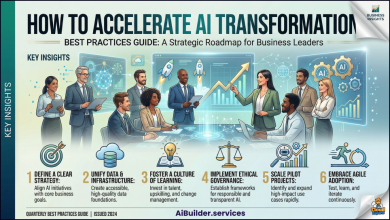
Scaling From AI Pilots into Full Enterprise Deployment
Successfully scaling AI demands more than better algorithms—it requires redesigned data foundations, industrialized MLOps, cultural alignment, governance at speed, and deliberate integration of human and machine intelligence.

 In the era of digital transformation, the ability to move artificial intelligence projects from experimental prototypes to robust, enterprise-wide production systems has become the defining competitive frontier for organizations across industries.
While developing an impressive proof-of-concept is now within reach for most companies, fewer than one in five successfully scale AI initiatives to deliver sustained business impact.
This persistent “pilot-to-production” gap is no longer just a technical challenge; it is the critical bottleneck that separates incremental efficiency gains from transformative reinvention of business models, customer experiences, and operational resilience.
Successfully scaling AI demands more than better algorithms—it requires redesigned data foundations, industrialized MLOps, cultural alignment, governance at speed, and deliberate integration of human and machine intelligence.
Organizations that master this transition consistently outperform peers in revenue growth, cost reduction, and innovation velocity, turning AI from a promising experiment into the central nervous system of their digital enterprise.
Driving Enterprise Impact
In this VB article ‘Why enterprise AI pilots fail — and how to move to scaled execution‘, Joyce Mullen describes how enterprise AI pilots frequently fail to deliver measurable business value, with MIT research estimating that 95% of such initiatives fall short—not due to a lack of ambition or poor technology, but primarily because of deployment and execution shortcomings.
Organizations often become trapped in “proof-of-concept purgatory,” where early experiments look impressive in presentations but cannot scale effectively. This pattern echoes past technology shifts like cloud adoption, but AI demands even faster and more disciplined implementation.
The core reasons for these failures center on organizational and operational issues rather than technical limitations. Leaders tend to fixate on the “what”—such as choosing the best model or automating isolated tasks—resulting in prolonged, expensive discovery phases driven by traditional consulting approaches that emphasize theory over rapid action.
Cultural resistance, skills gaps (cited by 44% of IT leaders in Insight’s 2024 survey as a major barrier), and insufficient deployment discipline compound the problem. Companies over-invest in algorithms (10%) and data/technology (20%) while neglecting the critical 70%—people, processes, and culture—as highlighted by the BCG 10-20-70 rule. Internal transformation is often overlooked; many enterprises attempt to deploy AI for customers without first mastering it themselves, leading to unproven concepts that fail under real-world conditions.
To transition from pilots to scaled execution, companies must prioritize building deployment muscle and treating AI as a core operational capability. Key steps include shifting to outcome-driven partnerships where fees tie directly to measurable business results rather than time-and-materials billing.
Accelerate progress by leveraging partners that provide immediate high-value use case inventories and actionable roadmaps, bypassing lengthy theoretical phases. Most importantly, focus on internal transformation first: prove the model by embedding AI across the organization, closing skills gaps, and fostering a culture of adoption.
Insight Enterprises, for example, achieved success by transforming internally, with 93% of its 14,000+ employees using generative AI daily and saving over 8,500 hours weekly. Frameworks like Insight’s PRISM methodology help inventory use cases early, balance innovation with governance, and drive continuous improvement.
Ultimately, the era of AI hype and isolated experiments is giving way to one defined by disciplined execution. As Joyce Mullen, President & CEO of Insight Enterprises, concludes, success belongs to the “doers” who operationalize AI at scale—much like previous digital transformations. The question for leaders is clear: How are you moving from hype to how, turning pilots into sustained, enterprise-wide value?