From Rules to Reasoning: A Learner’s Guide to the Era of AI Agents
Exploring AI's evolution from rigid, rules-based systems to adaptive AI agents that reason, plan, execute tasks, and learn from outcomes, driving the transition to collaborative digital teammates.

 The old version of AI was like a brain stuck in a jar. It was great at answering questions, but it could only sit there and respond. You typed a prompt, it gave one reply, and the conversation ended.
Now we’re stepping into the era of AI agents. These are no longer just clever chatbots. They are digital teammates with hands. They can think, make plans, take action, and keep working until the job is finished.
An AI agent is a smart assistant that understands a goal, creates its own plan, uses tools like web search or code, takes real steps, and learns from its mistakes. Instead of giving it every tiny instruction, you can hand it a big objective and let it figure out how to get there.
|
 Agentic Enterprise
 Plan Execute Loop
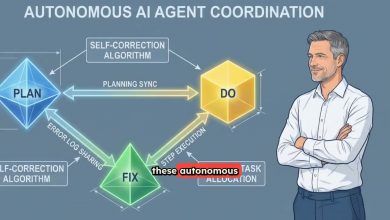
At the heart of every agent is a repeating cycle: perceive, plan, execute, and reflect. First it understands the goal and gathers information. Then it breaks the goal into clear steps. Next it uses tools to do the actual work. Finally, it checks the results. If something goes wrong, it fixes the problem and tries again. This loop allows agents to handle messy, real-world tasks that old software simply cannot manage.
Memory is what makes agents truly powerful. They use short-term memory to track what is happening in the current task, like a sticky note. They also build long-term memory, like a personal library, to remember past successes, important rules, and customer details. Because of this, agents do not start from zero every time. They get smarter and more efficient with every job.
Traditional automation worked with rigid if-then rules. It broke easily when something unexpected happened and was hard to update. AI agents are completely different. They reason flexibly, fix their own problems, focus on big outcomes instead of tiny tasks, and are much easier to build and change. Old automation is like following a strict recipe. An agent is like a clever chef who can improvise when ingredients are missing.
In real life, agents are already delivering results. For employee onboarding, an agent can pull HR data, send training materials, track progress, and even improve the process for the next new hire. In customer service, agents can handle refunds, troubleshoot problems, and solve complex issues from start to finish, saving teams many hours every month. Every task an agent completes makes the whole system smarter.
Of course, powerful agents need strong safety measures. Companies are adding human review for important decisions, emergency kill switches to stop agents instantly, and clear rules to keep them operating safely. Without these guardrails, giving agents too much freedom can become risky. Many teams are rushing to adopt agents but forgetting to install the brakes.
The good news is that you no longer need to be a coding expert. With today’s no-code tools, anyone can design and direct AI agents. The new key skills are turning big goals into smooth agent workflows, setting up proper oversight, checking performance, and building solutions using trusted ready-made pieces.
We are moving from simply telling computers what to do to working alongside digital teammates that can think and act on their own. The agent era has arrived. The only real question left is this: Will you be the one leading your team of AI agents, or will you be the one trying to catch up?
Multi-Agent
An AI agent is like a solo digital teammate. It takes a goal, thinks through a plan, uses tools, acts on it, checks the results, and keeps going until the job is done. Everything happens inside one smart unit. It keeps all the context in one place, makes decisions quickly, and works well for straightforward or moderately complex tasks.
A multi-agent system is more like a full team of specialists working together. Instead of one agent handling everything, you have several agents — each with its own strengths, memory, and tools. One might research, another analyzes, a third writes or executes, and they communicate, hand off work, or collaborate to reach the shared goal. An orchestrator (sometimes another agent) often coordinates the group.
Single agents shine when speed, simplicity, and low cost matter most. They are easier to build, test, debug, and maintain because everything lives in one spot. There is no back-and-forth communication, so responses come faster and token usage stays lower. They work great for well-defined jobs like answering FAQs, basic customer support, fraud detection on a single stream, or personal assistants that follow predictable steps. You avoid extra overhead, and governance stays straightforward.
Multi-agent systems unlock more power for bigger, messier challenges. Different agents bring specialized expertise, so the team can tackle complex projects that cross domains — like full research reports, enterprise workflows with compliance checks, or hospital patient coordination. They support parallel work (agents doing things at the same time), scale more easily by adding new specialists, and offer better fault tolerance: if one agent stumbles, the others can often keep going. The collective intelligence often delivers higher accuracy and more creative solutions on tough problems.
But that power comes with trade-offs. Multi-agent setups add coordination overhead — agents must talk, share state, and sync up, which increases latency, cost (more LLM calls), and complexity. Debugging becomes harder because issues can hide across multiple pieces. Security surfaces grow, and you need solid orchestration, clear rules for handoffs, and strong oversight to prevent chaos. Single agents can struggle when tasks get too broad or require strict separation of duties, while multi-agent systems risk becoming slow or unreliable without careful design.
In short, start with a single agent for most things. It is faster to launch, cheaper to run, and plenty capable for many real-world uses. Move to a multi-agent system when the work demands diverse skills, parallel execution, or clear boundaries between roles. The agent era began with capable solo players; multi-agent teams are what turn good AI into truly powerful digital workforces. The smartest approach is often to prototype with one agent first, then expand into a team only when the limits become clear.