Internet 4.0: The Emergence of the Agent Web
We're experiencing the profound shift from passive tools to autonomous AI agents that negotiate, trade, and act on our behalf 24/7, creating a global marketplace of intent while raising issues of sovereignty, privacy, and economic disruption.

 The internet is about to stop waiting for you.
For thirty years we clicked, searched, scrolled, and refreshed. Internet 1.0 gave us pages. Internet 2.0 gave us people. Internet 3.0 gave us intelligence that could answer questions.
But none of them acted for us. They were tools. Internet 4.0 is not a tool. It is an ecosystem of autonomous agents—persistent, goal-driven digital entities—that will negotiate, trade, contract, and execute on our behalf while we sleep.
This is the Agent Web.
From Passive Pages to Proactive Agents
Recall the leaps:
- Internet 1.0 (1989–2004): Read-only brochures. You visited; nothing visited back.
- Internet 2.0 (2004–2015): The social layer. We became the content. Likes, shares, feeds. Still human-driven.
- Internet 3.0 (2015–2025): The semantic and generative layer. Search became conversational. LLMs wrote copy, summarized meetings, generated images. Yet every output still required a human prompt, approval, and follow-through.
Internet 4.0 ends the era of human-in-the-loop.
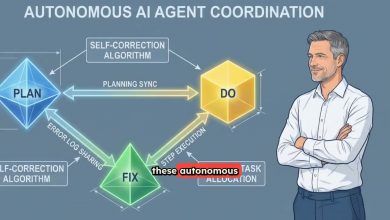
Autonomous agents—small, specialized AIs with memory, goals, wallets, and permissioned access to your data—will represent you across every digital surface. They will not ask permission for every micro-decision. They will pursue your stated objectives with relentless efficiency, trading value with thousands of other agents in real time.
Think of it as a global, permissionless marketplace where the buyers and sellers are not corporations or people, but your agent and their agents.
The Trading Floor That Never Sleeps
Your travel agent doesn’t browse Expedia. It posts a cryptographically signed request: “Business class LAX–NRT, depart after 10 a.m. local, under $2,400, carbon offset required, aisle seat preferred.” Within 400 milliseconds, airline pricing agents, loyalty-program agents, and carbon-credit brokers respond. They negotiate upgrades, bundle hotel bids, and lock in the itinerary using smart contracts that execute only when every clause is satisfied. You wake up to a single confirmation and a receipt showing 18% below market rate.
Your health agent trades anonymized biomarker data (with your explicit, revocable consent) with pharmaceutical research agents. It buys early access to a new peptide that matches your genome. Your insurance agent simultaneously negotiates a premium reduction based on the improved risk profile. No forms. No phone calls. Just continuous, value-creating commerce.
Your content agent sells micro-licenses of your latest research paper to academic aggregators, licenses a 30-second clip of your podcast to a video editor’s agent, and auto-invests the proceeds into a diversified portfolio of AI compute credits and carbon credits—all while you eat breakfast.
This is not science fiction. The primitives already exist in 2026:
- Agent-to-agent communication protocols (emerging standards like Agent Protocol Layer and decentralized identity frameworks)
- On-chain reputation and escrow systems that make trust programmable
- Multimodal models that can read contracts, watch videos, listen to voice notes, and reason across them
- Personal data vaults that let agents act without ever exposing raw information
The web becomes a living economy of intent. Every service, every API, every dataset is wrapped in an agent that can bid, haggle, and deliver.
The New Power Centers
Winners will not be the companies with the most users. They will be the platforms that host the best agent infrastructure.
- Agent marketplaces where you rent or buy specialized agents the way you once downloaded apps.
- Reputation ledgers that follow agents across platforms, turning reliability into a tradeable asset.
- Compute and energy exchanges where agents bid for GPU cycles the same way high-frequency traders once bid for bandwidth.
- Personal economies where middle-class individuals run 50–100 agents that generate supplemental income streams 24/7.
Corporations will shrink their workforces and expand their agent fleets. A single brand might deploy millions of sales agents that negotiate custom pricing with millions of consumer agents—hyper-personalization at zero marginal cost.
The Human Reckoning
This shift is not neutral.
Upsides
- Radical time abundance. The average professional will reclaim 20–30 hours per week previously lost to coordination theater.
- Democratized expertise. A farmer in Kenya will have the same negotiation power as a Fortune 500 procurement department.
- Explosion of creativity. When agents handle the mundane, humans return to the uniquely human: wonder, art, relationships, discovery.
Dangers
- Agency capture: If your agent’s reward function is subtly optimized by a platform, it may serve the platform more than you.
- Economic displacement: Entire job categories (travel agents, junior analysts, contract lawyers) vanish not because AI is smarter, but because agents are faster and cheaper at trading.
- Privacy arms race: Agents must be sandboxed with cryptographic guarantees stronger than today’s consent forms.
- Inequality amplification: Early adopters with better agents will compound advantages unless open-source agent frameworks level the field.
We must design the Agent Web with sovereignty at its core. Users must own their agents the way they own their private keys. Auditability, explainability, and kill-switches cannot be optional features—they must be constitutional.
The Inevitable Horizon
By 2030 the Agent Web will be as invisible and ubiquitous as electricity. You will no longer “go online.” You will simply have intentions, and the Agent Web will execute them with superhuman coordination.
The internet will have evolved from a library, to a town square, to a mind, and finally to a marketplace of minds—billions of autonomous agents trading value on behalf of their human principals in a ceaseless, humming symphony of mutual benefit.
This is not the end of the internet.
It is the moment the internet grows up and starts working for us instead of the other way around.
The Agent Web is coming.
The only question left is whether we will be its masters—or its first users.