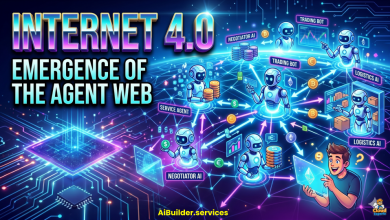
 In our recent exploration of Internet 4.0: The Emergence of the Agent Web, we detailed a profound shift: the transition from passive digital tools to an ecosystem of autonomous AI agents.
We envision a future where specialized digital entities negotiate, trade, and act on our behalf 24/7.
However, to build a bustling, global marketplace of intent, you first need infrastructure. Before agents can seamlessly negotiate your travel plans, broker micro-licenses for your content, or pay for API access, the internet needs new roads, traffic lights, verifiable identities, and a native financial layer.
Right now, we are in the messy transitional phase. The web is being flooded with AI crawlers, scrapers, and nascent agents. For website owners, creators, and small businesses, this traffic is largely unidentifiable and often parasitic. It drains resources and extracts value without returning it, breaking the traditional search-and-click economic model.
If Internet 4.0 is going to survive and thrive, it requires foundational innovations that establish trust, transparency, permissions, and seamless transactions. Fortunately, the architects of the web are already laying these bricks. The strategic partnership between Cloudflare and GoDaddy, combined with the emergence of new internet-native payment standards like x402, perfectly encapsulates the early innovations required to enable an open, transactional agentic web.
Here is a look at the foundational technologies and standards being forged today to make Internet 4.0 a reality.
1. Verifiable Identity: The Agent Name Service (ANS)
In the human web, we rely on domain names (DNS) and SSL certificates to know that a website is legitimate. But how do you verify an autonomous piece of code?
Enter the Agent Name Service (ANS). Introduced as an open standard by GoDaddy, ANS is designed to bring consistent naming, verification, and discovery to AI agents. Built on proven public key infrastructure (PKI) and DNS, ANS allows website owners to distinguish a legitimate, verified agent acting on behalf of a human or business from an unidentified, potentially malicious bot.
If an agent is going to initiate a smart contract or make a purchase on your behalf, its identity must be cryptographically signed. ANS provides this crucial verifiable identity layer.
2. Intent & Authentication: The Signature Agent Card & Web Bot Auth
Beyond just knowing a name, platforms need to know an agent’s purpose. Cloudflare’s introduction of Web Bot Auth and the Signature Agent Card provides a transparent way for agent developers to declare exactly who their agent is and what it is trying to achieve.
Think of it as a digital passport and visa combined. When an agent arrives at a digital storefront to negotiate a price or scrape a dataset, the Signature Agent Card transparently shares its intent. Web Bot Auth then uses cryptography to authenticate that the agent is exactly who it claims to be, establishing the baseline trust necessary for agent-to-agent (A2A) commerce.
3. A Permission-Based Economy: AI Crawl Control
In Internet 4.0, data is the currency. But currently, the extraction of that data is largely non-consensual. To build a fair ecosystem, power must be handed back to the creators and site owners.
This is where innovations like AI Crawl Control come into play. By integrating Cloudflare’s AI Crawl Control directly into GoDaddy’s hosting platform, millions of small businesses now have granular control over their digital borders. Website owners can set their own terms of engagement for visiting agents: they can allow them, block them entirely, or—crucially for the future of the agentic web—signal that payment is required for access.
This shifts the dynamic from quiet extraction to a transparent, permission-based value exchange.
4. The Native Economic Layer: x402 and Programmatic Payments
Once an agent’s identity is verified and a site signals that “payment is required” for access, how does the agent actually pay? The old internet relied on human behaviors—filling out credit card forms, completing KYC checks, and managing subscriptions or API keys. These friction points simply do not scale in a machine-to-machine economy.
To solve this, the industry is turning to x402, an open, neutral standard for internet-native payments. It revitalizes the historic, previously unfulfilled HTTP 402 (“Payment Required”) status code. With x402, a server can natively reject an unpaid request and prompt the AI agent to pay instantly and retry.
Instead of pre-purchasing credits or managing vulnerable API keys, an AI agent can execute micro-transactions instantly using stablecoins.
There are zero protocol fees, zero wait times, and zero human bottlenecks. Backed by major players like Stripe, AWS, and Cloudflare, x402 effectively absolves the internet’s “original sin” by finally baking an open financial layer directly into the HTTP protocol. This allows agents to natively buy and sell access, data, and compute power at the speed of the internet.
Securing the Value Exchange in the Answer Engine Era
The shift toward Internet 4.0 is effectively the end of the traditional traffic-based business model. As we move into an era of “Answer Engines”—where users receive synthesized answers directly from their personal agents rather than clicking through to a creator’s site—human-generated content must still be protected and compensated.
The infrastructure being deployed today isn’t just about cybersecurity; it’s about economics. By combining granular audit logs with transparent agent identity (ANS), access control, and frictionless micro-payments (x402), we are forging a new economic framework. It ensures that when an autonomous agent makes a request, it happens within a secure, accountable, and monetizable system.
The Inevitable Horizon, Grounded in Trust
The Agent Web will not be built solely on the back of faster Large Language Models or clever prompt engineering. It will be built on the unglamorous but essential plumbing of the internet: verifiable identity, access control, and programmatic, native payments.
The integration of standards like ANS, Web Bot Auth, and x402 are vital early signals. They show that the industry understands the stakes. If we want our agents to act as our digital proxies, we must build an environment where they can operate safely, transparently, and fairly. The Wild West phase of AI is ending; the era of the structured, verifiable, and transactional Agent Web has officially begun.